


An intense heat wave that has swept across Europe and that in France alone has caused more than 40 deaths has become sustained and prolonged due to an atmospheric phenomenon known as a “weather block”, or more precisely an “omega block”.
This phenomenon is so called because its shape on meteorological maps resembles the capital Greek letter omega (Ω). Essentially, it is a powerful area of high pressure and warm, stable air (anticyclone), which remains “trapped” between two low-pressure systems (cyclones) to its left and right.
This situation causes atmospheric conditions to remain unchanged for days or even weeks, keeping the heat and clear weather uninterrupted over the same areas.
How does weather “blocking” happen?
The term “block” refers to a situation when an area of warm, high-pressure air remains stationary and isolated for an extended period.
Under normal conditions, a strong air current in the atmosphere, known as the jet stream, constantly moves weather systems from west to east, bringing regular changes between sunshine and precipitation, as Reuters reports.
But during an omega blockage, this normal flow breaks down. The jet stream bends sharply north and south, “isolating” the pressure systems and keeping them stuck in the same place for days or weeks.
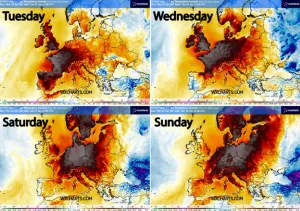
Under conditions of weaker winds and specific temperature contrasts in the atmosphere, this slow and “blocked” weather circulation pattern forms.
As a result, warm, stable air remains over the same area for days, without moving. Omega blockages typically last from three to ten days, but in more extreme cases they can persist for weeks.
The “heat dome” effect
At the center of this phenomenon, under the high-pressure area, the weather becomes extremely hot and dry. The high pressure acts as an atmospheric “lid” that prevents cloud formation, bringing a completely clear and sunny sky, which favors the continued increase in temperatures.
These conditions are currently “baking” France and Spain, where temperatures have exceeded 40°C. Meanwhile, in areas located within low-pressure systems, which surround this heat wave on both sides, there is a greater chance of cooler weather and rainfall.

A clear example is the United Kingdom, which is located on the border between high pressure and colder air in the northwest. According to data from the British Meteorological Service (Met Office), this situation brings intense heat to the south and east of the country, while lower temperatures and rainfall have been recorded in the north and west.
Link to climate change
Scientists are still not entirely unanimous on how climate change exactly affects the frequency of atmospheric blockages like this phenomenon.
However, the global scientific consensus is clear: climate change is increasing both the frequency and intensity of heat waves. Greenhouse gas emissions, mainly from the burning of coal, oil and gas, have warmed the planet by about 1.3 degrees Celsius compared to the pre-industrial era.
This means that each new heat wave starts from a higher base of temperatures and reaches more extreme levels.
“Today Europe is experiencing heatwaves that are 2 to 4°C hotter than they would be without human-caused global warming,” explained Clair Barnes, a researcher on extreme weather and climate at Imperial College London.
In conclusion, when natural atmospheric phenomena such as the omega lock coincide with a climate already warmed by climate change, the heat that is created becomes much more intense and significantly more dangerous. /Telegraph/